🦞 4minAI.com
1 / 13
Day 27 of 28 Β· AI Challenge

Scaling with AI

There's a ceiling to trading time for money. Even if you charge $200/hour, there are only so many hours in a day.

Scaling is about breaking through that ceiling β€” doing more without working more. It's about building systems that multiply your output without multiplying your effort.

Today you'll learn how to delegate to AI, build repeatable systems, and know exactly when you need a human instead of a machine.

The scale mindset

Most people think scaling means hiring a team. It can. But before you hire anyone, there's an enormous amount of growth you can capture by building AI-powered systems.

Think of it this way:

Level 1: You do everything yourself. Every task, every client, every deliverable. This works for 1–3 clients. Then you hit a wall.

Level 2: You use AI for individual tasks. You use ChatGPT to write faster, research faster, analyze faster. This is where most people in this challenge are right now. It works for 3–8 clients.

Level 3: You build AI systems. Instead of using AI one task at a time, you create repeatable workflows β€” templates, processes, and automations that handle entire categories of work. This is where you can serve 10–20+ clients without burning out.

Level 4: You combine AI systems with humans. You hire a VA or assistant to handle the parts AI can't (client relationships, creative judgment, complex strategy) while AI handles everything else. This is how solo operators build $200K–$500K businesses.

Knowledge Check
What's the key difference between using AI and building AI systems?
A
Building systems is only for large companies
B
Using AI handles one task at a time β€” building systems creates repeatable workflows that handle entire categories of work automatically
C
Building systems requires coding skills
D
There's no real difference
Using AI for individual tasks is like using a calculator β€” helpful but manual. Building AI systems is like creating a spreadsheet with formulas that runs calculations automatically every time. The system does the work repeatedly without you re-inventing the process each time.

What to delegate to AI (and what to keep for yourself)

Not everything should be delegated. Here's a practical framework:

Delegate to AI β€” high volume, repeatable, structured:

- First drafts of content (blog posts, emails, social media)

- Research and data gathering

- Report formatting and visualization

- Template-based deliverables (proposals, invoices, summaries)

- Meeting notes and action items

- Client onboarding documents

- Scheduling and calendar management

Keep for yourself β€” high judgment, relationship-based, creative:

- Final review and quality control

- Client strategy conversations

- Pricing negotiations

- Creative direction and brand voice decisions

- Relationship building and networking

- Complex problem-solving that requires context AI doesn't have

The rule of thumb: if you do it more than 3 times and it follows a pattern, build a system.

Knowledge Check
Which of these tasks should you delegate to AI?
A
A sensitive negotiation with a long-term client about raising rates
B
Deciding whether to pivot your business model
C
Creating first drafts of weekly client reports from analytics data
D
Building a personal relationship with a new referral partner
Weekly client reports follow a predictable pattern β€” pull data, summarize trends, highlight key metrics, format consistently. This is a perfect AI delegation candidate. The strategic and relational tasks require human judgment, empathy, and context that AI can't replicate.

Building your first AI system

Let's build a real system. Say you have a content writing service with 5 clients, each getting 4 blog posts per month. That's 20 posts β€” a lot of work.

Here's the system:

Step 1: Client brief template. Create a standard questionnaire that captures everything you need β€” target audience, tone, topics, keywords, competitors. AI helps you build this template once.

Step 2: Research automation. For each post, feed AI the topic and client brief. It researches keywords, analyzes top-ranking articles, and identifies content gaps. 10 minutes instead of 45.

Step 3: First draft generation. Using the research and brief, AI generates a structured first draft. You've built prompts that consistently produce 80% finished content. 15 minutes instead of 2 hours.

Step 4: Editing checklist. You review against a standard checklist: brand voice, accuracy, SEO, readability. AI helps with some checks, you handle final judgment. 20 minutes instead of 45.

Step 5: Delivery template. Formatted in the client's preferred style, with a standard cover note summarizing the post and its SEO targets. 5 minutes instead of 15.

Total time per post: ~50 minutes instead of ~3.5 hours.

Total time for 20 posts: ~17 hours instead of ~70 hours.
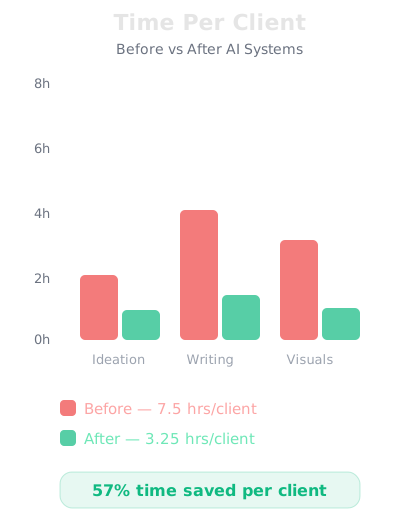
Bar chart comparing time spent per client before and after AI systems
AI systems cut per-client time by more than half β€” across ideation, writing, visuals, and analytics.

That's 53 hours freed up every month. Use them to get more clients, build a side project, or enjoy your life.

πŸ€–
ChatGPT
online
I'm a freelance social media manager with 6 clients. I'm maxed out at 45 hours per week and can't take on more work. Help me build a scaling plan so I can grow to 12 clients without doubling my hours.
Let's analyze your current time breakdown and optimize it. **Current state (estimated per client, per week):** - Content ideation: 1 hour - Writing posts/captions: 2 hours - Finding/creating visuals: 1.5 hours - Scheduling and publishing: 0.5 hours - Analytics and reporting: 1 hour - Client communication: 1.5 hours - **Total: ~7.5 hours Γ— 6 clients = 45 hours/week** **Your AI-powered scaling plan:** πŸ€– **Content ideation β†’ AI system** Build a prompt template per client that generates 4 weeks of content ideas from their niche, trending topics, and past top-performers. Time: 1 hour β†’ 15 minutes. πŸ€– **Writing posts β†’ AI system** Create client-specific prompt templates with brand voice, key phrases, and formatting rules. AI drafts, you edit. Time: 2 hours β†’ 40 minutes. πŸ€– **Analytics β†’ AI system** Build a reporting template. Paste in raw data, AI generates the summary and recommendations. Time: 1 hour β†’ 20 minutes. πŸ‘€ **Client communication β†’ keep human** This is relationship work. Don't automate it. But batch your calls β€” 2 call days per week instead of scattered throughout. πŸ“Έ **Visuals β†’ partial automation** Use Canva templates with AI-generated copy. Create 5 base templates per client, then swap text and images. Time: 1.5 hours β†’ 30 minutes. **New time per client: ~3.25 hours/week** **12 clients Γ— 3.25 hours = 39 hours/week** You just doubled your client base while working fewer hours. Revenue goes from ~$6,000/month to ~$12,000/month.
When does it make sense to actually hire someone instead of using AI?
Great question. Here's the decision framework: **Hire a human when:** πŸ‘€ **Relationship work** β€” Client calls, strategy sessions, crisis management. AI can prep you, but the human connection matters. πŸ‘€ **Quality control at scale** β€” When you have 15+ clients, you need a second set of human eyes reviewing AI output. πŸ‘€ **Tasks requiring real-time judgment** β€” Responding to trending events, handling PR issues, making brand-critical decisions. πŸ‘€ **Your time is the bottleneck** β€” If your hourly rate is $100+ and a VA costs $20/hour for tasks you can train them on, the math is obvious. **Keep using AI when:** πŸ€– The task is repeatable and follows a pattern πŸ€– Quality can be verified with a checklist πŸ€– Speed matters more than nuance πŸ€– The output is a first draft, not the final product **Your ideal first hire:** A part-time VA (10–15 hours/week, $15–$25/hour) who handles scheduling, basic client comms, and initial quality checks. You train them on your AI systems. Cost: ~$800–$1,500/month against $12,000/month revenue. Easy decision.
↻ Replay conversation

The compound effect of systems

Here's what most people miss about scaling: the benefits compound.

Month 1: You build your content system. You save 10 hours per week.

Month 2: You use those 10 hours to build a reporting system. Now you save 15 hours per week.

Month 3: You use the freed-up time to take on 3 more clients. Revenue goes up 40%.

Month 4: You hire a part-time VA to handle scheduling. You save another 8 hours per week.

Month 6: You're serving twice as many clients, earning twice as much, and working roughly the same hours you did when you started.

Each system you build makes the next one easier, because you understand the pattern: identify the repeatable task, build the AI workflow, create the template, document the process.

This is how solo operators build six-figure businesses without six-person teams.

Knowledge Check
What's the most effective first step toward scaling an AI-powered freelance business?
A
Immediately hire a full-time employee
B
Raise your prices and hope for the best
C
Identify your most time-consuming repeatable task and build an AI system to handle it
D
Take on more clients and work longer hours
Start with the biggest time sink that follows a pattern. Build one system, reclaim those hours, then use the freed time to build the next system or take on more clients. It's a progressive approach that grows sustainably instead of leading to burnout.
Final Check
A freelancer working 40 hours/week serving 5 clients builds AI systems that cut their per-client time in half. What's the smartest next move?
A
Work 20 hours and relax
B
Immediately take on 10 clients to fill all 40 hours
C
Gradually take on 3–4 more clients while using some freed time to build additional systems and improve quality
D
Lower prices since they're working less
Sustainable scaling means growing gradually. Take on a few more clients to increase revenue, invest some freed time in building more systems, and maintain quality. Doubling clients overnight risks burnout and service quality issues. Gradual growth with continuous system-building is the proven path.
πŸ“ˆ
Day 27 Complete
"Scale doesn't mean working more. It means building systems that multiply your output while your effort stays constant."
Tomorrow β€” Day 28
Your AI-Powered Future
Tomorrow is the final day β€” we bring it all together.
πŸ”₯1
1 day streak!