🦞 4minAI.com
1 / 12
Day 14 of 28 Β· AI Challenge

Your Content Machine

Congratulations β€” you just finished Week 2. Take a moment to recognize what you've built over the last seven days. Not just individual skills, but a system. A content and marketing machine that works together.

Let's zoom out and see the full picture.

What you built this week

Here's everything you now have in your toolkit:

Day 8 β€” Social Media Content. The framework for creating platform-specific posts (topic, angle, hook, body, CTA) and repurposing one idea across LinkedIn, Twitter/X, and Instagram.

Day 9 β€” Copywriting. The AIDA framework for writing landing pages, ads, and CTAs that drive action. Headlines that stop the scroll. Ad copy that converts.

Day 10 β€” Content Calendar. Content pillars, a monthly plan, and the batching method that creates 30 days of content in one afternoon.

Day 11 β€” SEO. Keyword research, search intent, content optimization β€” the strategy for getting found by people already searching for what you offer.

Day 12 β€” Visual Design. AI image generation, Canva workflows, brand consistency, and presentation design that makes your business look polished.

Day 13 β€” Email Marketing. Welcome sequences, newsletters, subject lines, and automation that nurtures leads while you sleep.

That's not six random skills. That's a complete content and marketing system.

Knowledge Check
Which piece of the content system generates traffic for months or years without ongoing effort?
A
SEO-optimized blog content
B
Email welcome sequences
C
Social media posts
D
Ad copy
Social media posts have a lifespan of 24-48 hours. Emails reach existing subscribers. Ad copy requires ongoing ad spend. But a well-optimized blog post ranks on Google and brings in new visitors every day for months or years β€” compounding traffic with zero additional effort.

The content flywheel

Here's the thing most people miss: these pieces don't just work individually. They compound.

It starts with one piece of content β€” say, a blog post optimized for SEO. That post ranks on Google and brings in new visitors. Some of those visitors join your email list. Your welcome sequence builds trust and pitches your offer. Meanwhile, you repurpose the blog post into 3 social media posts. Those posts drive more people to the blog. More blog visitors join the email list. The flywheel spins faster.

Here's the flow:
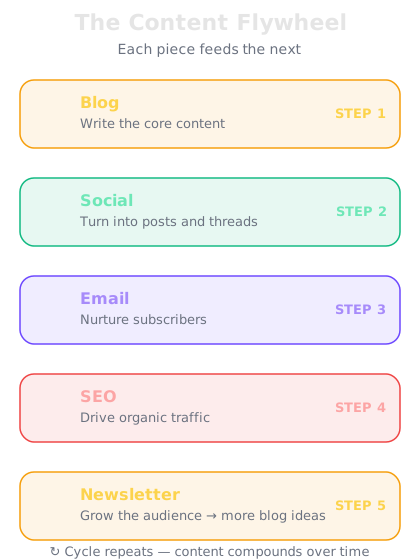
Content flywheel showing Blog, Social, Email, SEO, and Newsletter feeding into each other
Each piece of content feeds the next β€” that's a flywheel, not a treadmill.

SEO blog post drives traffic. Social media posts (repurposed from the blog) drive more traffic and build your audience. Email opt-in captures visitors. Welcome sequence nurtures them. Newsletter keeps you top-of-mind. Copywriting converts them when they're ready to buy.

Every piece feeds the others. That's a flywheel, not a treadmill. A treadmill requires constant effort just to stay in place. A flywheel builds momentum β€” each push makes the next one easier.

πŸ€–
AI Assistant
online
I'm a freelance brand designer. Map out a specific content flywheel for my business. Show me exactly how one piece of content becomes multiple touchpoints that feed each other.
Here's your content flywheel β€” starting from one blog post: **1. SEO Blog Post (Monday)** "5 Signs Your Brand Needs a Redesign" β†’ Optimized for the keyword "when to rebrand your business" β†’ Targets small business owners searching Google β†’ Includes a free "Brand Health Checklist" download (email opt-in) **2. Social Media Repurposing (Tue-Thu)** β†’ LinkedIn: Long-form post with your top 3 signs + personal story of a client rebrand β†’ Twitter/X: Thread breaking down all 5 signs with before/after examples β†’ Instagram: Carousel β€” each slide is one sign with a visual example β†’ All posts link back to the full blog post **3. Email Capture** β†’ Blog visitors download the Brand Health Checklist β†’ They enter your welcome sequence (built on Day 13) β†’ Email 1: Delivers the checklist β†’ Email 2: Your story β€” why you became a brand designer β†’ Email 3: Case study β€” a client who rebranded and saw results β†’ Email 4: "Ready to talk about your brand? Book a free 15-min audit" **4. Newsletter Mention (Friday)** β†’ Weekly newsletter features the blog post as your "insight of the week" β†’ Drives existing subscribers back to the blog (boosting SEO signals) **5. The Compounding Effect** β†’ Blog ranks higher as it gets traffic and engagement β†’ Social posts drive new followers who see future content β†’ Email list grows with every blog visitor β†’ Each week's content builds on the last One blog post. Seven pieces of content. Multiple entry points. All feeding the same funnel. Want me to plan your first month using this flywheel?
↻ Replay conversation
Knowledge Check
What's the difference between a content treadmill and a content flywheel?
A
A flywheel requires more content than a treadmill
B
A treadmill requires constant effort to maintain; a flywheel builds momentum where each piece amplifies the others
C
A treadmill is faster; a flywheel is slower
D
There's no real difference β€” it's just a metaphor
A treadmill means you're starting from zero every day β€” if you stop, everything stops. A flywheel means each piece of content feeds the next. Blog posts fuel social posts. Social posts drive email signups. Emails drive sales. And every new piece makes the whole system more powerful. That's the difference between hustling and building.

You now have a system

Before this week, content was probably something you did when you felt inspired. Or felt guilty for not posting. Or scrambled to create because someone said you "need to be on social media."

Now you have a system. You know what to create (pillars), where to publish (multiple platforms from one idea), how to write it (frameworks like AIDA and the hook-body-CTA structure), how to get found (SEO), how to look professional (AI visuals), and how to nurture people into customers (email).

And every piece of this system is powered by AI. What used to take a marketing team of three people and 40 hours a week, you can now do solo in 5-8 hours a week. That's not an exaggeration β€” that's the math:

- Content calendar planning: 1 hour/month (about 15 min/week)

- Writing and editing posts: 2-3 hours/week (batched)

- Blog post with SEO: 2 hours/week (one post)

- Newsletter: 20-30 minutes/week

- Email sequence setup: Front-loaded (a few hours once, then it runs on autopilot)

The people who see the biggest results from this course aren't the ones who learn the most β€” they're the ones who build the system and run it consistently.

Final Check
What's the single most important thing to do with the content system you've built?
A
Run it consistently β€” a good system executed weekly beats a perfect plan that never launches
B
Wait until you have a large audience before starting
C
Perfect every piece before publishing
D
Create as much content as possible
Consistency beats perfection. A weekly blog post, three social posts, and a newsletter β€” published reliably every week β€” will outperform sporadic bursts of brilliant content. The system only works if you run it. Start this week. Not when it's perfect. Now.

What's next

Week 3 shifts gears. You've built the content machine. Now it's time to automate the rest of your business.

Next week, you'll learn to use AI for automating repetitive tasks, managing clients, handling finances, streamlining operations β€” all the behind-the-scenes work that eats your time and energy.

The content system runs in the background, generating leads. Week 3 frees up the hours to actually serve those leads and grow your income.

You're halfway there. And you already have more marketing firepower than most businesses with full-time marketing teams.

πŸš€
Day 14 Complete β€” Week 2 Done
"You don't have scattered posts anymore β€” you have a content machine. Pillars, calendar, copy, SEO, visuals, email. One system. Now run it."
Tomorrow β€” Day 15
Automating Repetitive Work
Week 3 begins β€” time to automate the boring stuff and work on what matters.
πŸ”₯1
1 day streak!