Day 13 of 28 · AI Job Hunt
Building a Portfolio with AI
⏱ 5 min
📊 Beginner
"Do you have a portfolio?" This question intimidates people who aren't designers or developers. But here's the thing — every professional can have a portfolio. It's not about pretty images. It's about proving you can do what you claim.
Today, AI helps you build case studies and work samples that show your impact — even if you've never had a "portfolio" before.
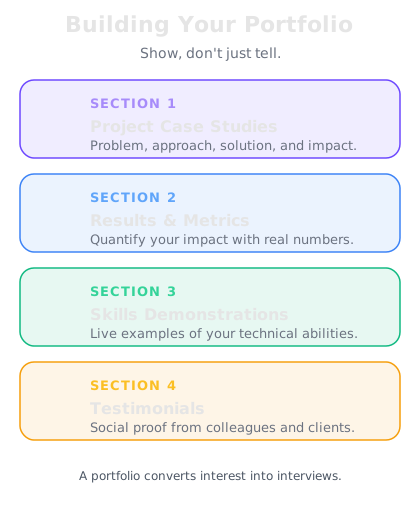
Show, don't just tell. Prove your value with evidence.
What counts as a portfolio
A portfolio is simply evidence of your work and its impact. For different roles, this looks different:
Marketing: Campaign results, content samples, strategy documents, growth metrics.
Operations: Process improvements with before/after metrics, workflow documentation, cost savings analysis.
Sales: Deal case studies, outreach templates that worked, revenue growth stories.
Product: Feature launch summaries, user research insights, roadmap documents.
Customer Success: Retention stories, account growth examples, QBR templates.
Management: Team growth metrics, hiring frameworks, project delivery timelines.
You don't need a fancy website. A well-organized Google Doc or Notion page with 3-5 case studies is enough to set you apart from candidates who show up with nothing but a resume.
Knowledge Check
What does a portfolio prove that a resume can't?
B
That you can actually do the work — it shows your thinking process, your approach, and your real results with depth that resume bullets can't capture
C
That you have a website
D
That you spent a lot of time preparing
A resume says "I increased retention by 15%." A case study shows HOW — the problem you identified, your approach, the obstacles you overcame, and the measurable result. That depth of evidence is what turns an interview from "tell me about a time..." to "I can already see you doing this job."
I'm a customer success manager and I don't have a portfolio. Help me create a case study from this experience: I inherited an account that was at risk of churning ($150K ARR). The client was frustrated with our product's reporting features. I worked with the product team to get their feedback prioritized, ran weekly check-ins with the client, and rebuilt the relationship over 3 months. They renewed and expanded by $50K.
**Case Study: Saving a $150K Account and Driving $50K Expansion**
**The Situation:**
Inherited a high-value account ($150K ARR) flagged as high churn risk. The client's primary frustration: our product's reporting capabilities weren't meeting their enterprise needs. Relationship with previous CSM had deteriorated.
**The Challenge:**
- Client considering competitor evaluation at next renewal
- Reporting gaps were real — not a perception problem
- Trust deficit from previous account management
**My Approach:**
1. Conducted a deep-dive discovery call to understand their specific reporting needs (not just complaints)
2. Documented 5 specific feature requests and presented them to our product team with business case
3. Established weekly check-ins to rebuild trust and show progress
4. Created custom workaround reports using our API to bridge the gap while product built native solutions
5. Connected the client with our product team directly — they felt heard
**Results:**
- Account renewed at full value ($150K)
- Client expanded by $50K (33% growth) within 3 months of renewal
- 2 of 5 feature requests shipped, used by 40+ other enterprise accounts
- Client became a reference account for future enterprise deals
**Key Takeaway:**
At-risk accounts are often a listening problem, not a product problem. The client didn't just want better reports — they wanted to feel like a priority. The technical fix mattered, but the relationship rebuild is what drove the expansion.
---
This case study demonstrates: stakeholder management, cross-functional collaboration, strategic account planning, and revenue expansion.
↻ Replay conversation
Creating case studies for confidential work
"But I can't share details about my work — it's confidential." This is the most common objection. Here's how to handle it:
Anonymize the details. Change company names, round the numbers, generalize the industry. "A $150K enterprise SaaS account" becomes "a six-figure enterprise technology account." The story and your skills remain intact.
Focus on your approach, not the client. Case studies aren't about the company — they're about how YOU think and work. "I identified that the core issue was a reporting gap, not a relationship problem" doesn't reveal any confidential information.
Use AI to anonymize. Paste your real experience into AI and ask it to create an anonymized case study that preserves your methodology and results while removing identifying details.
Knowledge Check
How should you handle confidential work experience in a portfolio?
A
Only include work from your first job when NDAs didn't apply
B
Anonymize the details while preserving your approach and methodology — change names, round numbers, and generalize the industry
C
Don't include it at all
D
Share the real details — companies won't find out
Anonymized case studies are standard practice. No reasonable hiring manager expects you to reveal client names or exact figures. What they want to see is your thinking process, your approach to problems, and evidence that you delivered results. All of that can be shared without breaking confidentiality.
Your portfolio action plan
You need 3-5 case studies. Here's how to create them this week:
Step 1: List your top 5 professional achievements — times you solved a problem, delivered results, or made an impact.
Step 2: For each one, paste the details into AI with this prompt: "Turn this experience into a professional case study with these sections: Situation, Challenge, Approach, Results, Key Takeaway. Anonymize any confidential details. Keep it to 200-300 words."
Step 3: Compile them into a clean Google Doc or Notion page.
Step 4: Add the link to your resume header and LinkedIn profile.
Three to five case studies, created in about 30 minutes. That puts you ahead of 95% of candidates who show up with nothing but a resume.
Final Check
How many case studies should your portfolio include?
A
As many as you can create
B
10+ to cover every possible skill
C
Just 1 — quality over quantity
D
3-5 — enough to show a pattern of success across different situations, without overwhelming the reader
Three to five case studies is the sweet spot. It's enough to demonstrate that your success isn't a one-time fluke — it's a pattern. More than that and people won't read them. Fewer than that and it might seem like you only have one good story.
📁
Day 13 Complete
"A resume tells them what you did. A portfolio shows them how you think. That's the difference between a callback and an offer."
Tomorrow — Day 14
Your Application Machine
Tomorrow you'll put everything together into a repeatable system that produces tailored applications fast.