Day 25 of 28 · AI Job Hunt
Your 90-Day Plan
⏱ 5 min
📊 Beginner
You got the job. Now what? The first 90 days at a new job are the highest-leverage period of your entire tenure. First impressions get set. Expectations get established. Your reputation gets built.
Most people coast through their first months — learning the systems, meeting people, and finding their way. Today, you'll build a strategic 90-day plan that accelerates you from "new hire" to "indispensable" — and sets you up for an early promotion.
Start strong and set yourself up for an early promotion.
The 30-60-90 framework
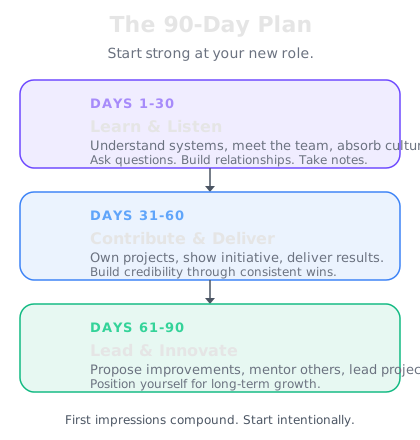
The best 90-day plans follow three phases:
Days 1-30: Listen and learn. Your only job is to understand — the company, the team, the processes, the culture, the unspoken rules. Take more notes than you think necessary. Ask more questions than feels comfortable. Build relationships before trying to change anything.
Days 31-60: Contribute and connect. Start delivering visible wins. Identify one process you can improve or one project you can own. Deepen your cross-functional relationships. Start connecting what you learned in month 1 to real contributions.
Days 61-90: Lead and propose. Bring a strategic recommendation to your manager. Propose something that goes beyond your job description. Show that you're thinking about the team's success, not just your own tasks.
Knowledge Check
What should your primary focus be during the first 30 days at a new job?
A
Identifying everything that's wrong and presenting a list to your manager
B
Keeping a low profile until you're fully comfortable
C
Listening and learning — understanding the company, team, processes, and culture before trying to contribute or change anything
D
Making as many changes as possible to show your value
The biggest mistake new hires make is trying to "add value" too quickly. In the first 30 days, your job is to absorb — the context, the relationships, the unspoken rules, and the real priorities (which are often different from what's on the job description). This foundation makes your contributions in months 2 and 3 dramatically more effective.
I'm starting a new Product Marketing Manager role at a Series B SaaS company next week. Help me create a specific 90-day plan. The company has 150 employees, just launched an enterprise product, and I'm the first dedicated PMM hire.
**Your 90-Day Plan: First PMM at a Series B SaaS Company**
**Days 1-30: Listen, Learn, Map**
- Week 1: Meet your manager, sales team, product team, and CS team. Ask each: "What's working? What's broken? What do you wish marketing did better?"
- Week 2: Audit existing materials — sales decks, website messaging, competitor analysis, product docs. Note gaps.
- Week 3: Sit in on 3-5 sales calls and 2-3 CS calls. Listen to how customers talk about the product.
- Week 4: Document your findings in a "State of Product Marketing" brief. Share with your manager.
- **Deliverable:** A written landscape assessment that shows you understand the business.
**Days 31-60: Quick Wins and Foundation**
- Deliver one immediate high-impact asset (battle card, updated pitch deck, or competitive one-pager) based on your audit
- Build a messaging framework for the enterprise product (positioning statement, key differentiators, proof points)
- Create a launch playbook template for future product releases
- Start building relationships with 3-5 key sales reps — become their go-to person
- **Deliverable:** One shipped asset + a messaging framework draft for review.
**Days 61-90: Strategic Impact**
- Propose a go-to-market plan for the next major feature or market expansion
- Present your messaging framework to leadership and get buy-in
- Identify the top 3 PMM priorities for the next quarter and align with your manager
- Set up a regular sync with sales and product to create a feedback loop
- **Deliverable:** A quarterly PMM roadmap and one strategic recommendation.
**The key impression to make:** "She didn't just fill a role — she built a function."
↻ Replay conversation
Using AI in your new job
Here's the secret weapon nobody talks about: use AI to accelerate your onboarding. In the first 30 days, you're drowning in information. AI helps you process it:
Summarize meeting notes. After every meeting, paste your notes into AI: "Summarize the key takeaways and action items from this meeting."
Research internal topics. "Explain [industry concept] to me like I'm starting a new role and need to get up to speed quickly."
Prepare for 1-on-1s. "I have a meeting with the VP of Sales tomorrow. Based on what I've learned so far [context], what questions should I ask?"
Draft your 30-day summary. "Here's everything I've learned in my first month [paste notes]. Help me organize this into a 'State of Product Marketing' brief."
The people who ramp fastest aren't necessarily smarter — they process information more efficiently. AI is how you do that.
Knowledge Check
What's the most valuable thing you can deliver in your first 30 days?
A
A complete strategy overhaul
B
A written landscape assessment that shows your manager you understand the business, the team, and the opportunities — before you start proposing changes
C
Three new marketing campaigns
A thoughtful landscape assessment does two things: it proves you've been listening (which builds trust), and it sets the foundation for everything you'll propose in months 2 and 3. It also shows strategic thinking — you didn't just jump to solutions, you took time to understand the real problems first.
Setting up your promotion case early
It sounds aggressive, but the smartest thing you can do in your first week is ask your manager: "What does success look like for this role in 12 months? And what would it take to earn a promotion or expanded scope?"
This question does three things:
1. It shows ambition (positive signal)
2. It gives you a clear target to work toward
3. It creates a documented benchmark so your promotion isn't subjective
Then use AI to track your progress against those goals. Every month, document your contributions, wins, and impact. When review time comes, you won't need to remember — you'll have a file full of evidence.
Final Check
When should you start building your case for a promotion at a new job?
A
After 6 months when you've proven yourself
B
After your first annual review
C
In your first week — by asking your manager what success looks like and what a promotion requires, then tracking your progress from day one
D
Never — promotions happen naturally
The people who get promoted fastest aren't the ones who suddenly ask for a promotion — they're the ones who aligned on criteria from day one and documented their progress along the way. When you walk into a review with "you said success looks like X, here's how I delivered X, Y, and Z," the conversation is about when — not whether.
🚀
Day 25 Complete
"The first 90 days aren't about surviving your new job. They're about setting the trajectory for your entire career at this company. Start strong."
Tomorrow — Day 26
Building Your Professional Brand
Tomorrow you'll learn long-term career positioning that keeps opportunities coming to you forever.