Your Job Hunt Foundation
Seven days. That's all it took.
One week ago, you might have been sending the same resume to every job and hoping for the best. Now? You have a complete strategic foundation — a skills assessment, a target role, decoded job descriptions, a career narrative, and an AI toolkit that does in minutes what used to take hours.
Let's take stock of how far you've come.
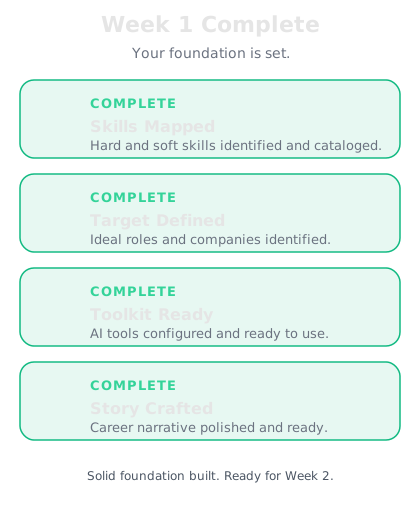
What you built this week
Day 1 — Mindset shift. You learned that job hunting isn't a numbers game — it's a precision game. AI changes the math by letting you personalize at scale.
Day 2 — Skills assessment. You discovered that your experience is worth more than you thought. The operations coordinator who "handled scheduling" became someone who "redesigned routing processes saving 15% on fuel costs." Same person, completely different resume.
Day 3 — Your toolkit. You set up ChatGPT, Claude, and Perplexity — and learned when to use each one. More importantly, you learned the golden rule: context before output.
Day 4 — Target role. Instead of browsing randomly, you used AI to map your skills to specific roles, research market demand, and build a focused target list.
Day 5 — Job description decoding. You learned to read between the lines of any posting — separating must-haves from nice-to-haves, extracting keywords for ATS, and identifying the real problem the company is hiring to solve.
Day 6 — Career story. You built a narrative that connects your past to your future — one that makes interviewers lean in instead of zone out.
The compound effect of preparation
Here's what most job seekers don't understand: preparation compounds.
When you walk into an interview having decoded the job description, researched the company, prepared a tailored career story, and practiced likely questions — you look like a completely different caliber of candidate.
The interviewer doesn't know you used AI. They just know that you seem remarkably prepared, articulate, and intentional. You reference specific company challenges. Your career story flows naturally. Your resume mirrors their exact language.
That "preparation effect" is worth more than an extra degree or 3 more years of experience. And AI makes it achievable for every single application.
What's coming in Week 2
You've built the foundation. Week 2 is where you build your weapons:
Day 8 — The AI-Optimized Resume. Build a resume from scratch that's designed to beat ATS systems and impress human readers.
Day 9 — Beating Applicant Tracking Systems. Deep-dive into exactly how ATS works and how to make sure your resume never gets filtered out.
Day 10 — Cover Letters That Get Read. Write cover letters that hiring managers actually want to read — in under 5 minutes each.
Day 11 — LinkedIn Profile Makeover. Transform your LinkedIn into a recruiter magnet with AI-optimized sections.
Day 12 — LinkedIn Content Strategy. Become visible to recruiters and hiring managers through strategic content.
Day 13 — Building a Portfolio with AI. Create case studies and work samples that prove your value — even if you don't have a traditional portfolio.
Day 14 — Your Application Machine. Put it all together into a repeatable system that produces tailored applications fast.
Week 1 gave you the strategy. Week 2 gives you the materials.