Writing Property Listings That Sell
A great listing description doesn't just describe a property — it sells a lifestyle. It makes the buyer picture themselves living there before they've even booked a viewing. Most listings fail at this. They read like inventory checklists: three beds, two baths, garage, garden. Functional, forgettable.
Today you're going to learn the anatomy of a listing that actually compels action, and you'll get AI prompt templates that produce compelling copy for any property type — luxury, family, investment, or first-time buyer.
Why most listings don't work
Open any property portal right now — Rightmove, Zillow, Domain, Realtor.com — and read ten listings. You'll notice something immediately: they all sound the same.
"This well-presented three-bedroom property benefits from a spacious lounge, modern kitchen, and rear garden. Close to local amenities and transport links. Viewing recommended."
That description could be any house, in any city, in any country. It tells you what the property has but not why you should care. There's no emotion, no personality, no reason to click "Book a Viewing" instead of scrolling to the next listing.
The difference between a listing that generates viewings and one that gets scrolled past comes down to two things: emotional connection and specificity.
The anatomy of a listing that sells
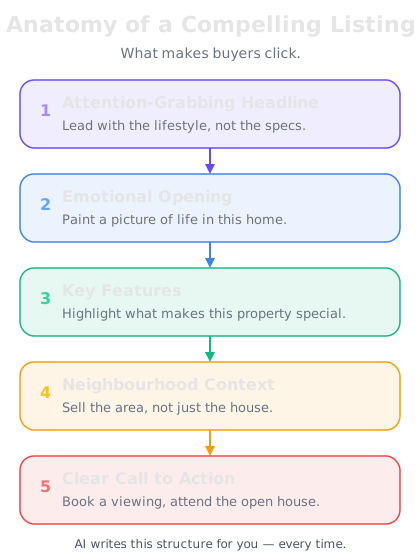
Every high-performing listing follows this structure, whether it's a studio flat in London or a ranch in Texas:
1. The headline hook — One line that captures attention. Not "3 Bed Semi-Detached" but "The Best Street in Didsbury — Reimagined Victorian Living." The headline should make someone stop scrolling.
2. The emotional opening — Two to three sentences that set the scene. Paint a picture of what living here feels like. "Step through the front door and the first thing you'll notice is the light — natural sunlight streaming through original sash windows into a hallway that's been lovingly restored."
3. Feature-benefit pairs — Don't just list features. Connect each one to how it improves the buyer's life. Not "south-facing garden" but "a south-facing garden that catches the afternoon sun — perfect for weekend barbecues or quiet evenings with a glass of wine."
4. The lifestyle close — Tie the property to the area. "With Clapham Common on your doorstep and the Northern Line a three-minute walk away, you get village living with Zone 2 convenience."
5. Call to action — Create urgency. "Viewings are being booked for this weekend. Contact us today to avoid disappointment."
Emotional vs. factual copy
Here's the same property described two ways:
Factual (most agents):
"Three-bedroom detached house with two bathrooms. Recently renovated kitchen with island. Double garage. Large rear garden. Walking distance to schools."
Emotional (what sells):
"Imagine Sunday mornings in this kitchen — coffee brewing on the island while the kids play in the garden you can see through the bifold doors. This is a home designed for the moments that matter. Three bedrooms give everyone their own space, the double garage swallows two cars plus all the bikes and camping gear, and the best primary school in the catchment is a five-minute walk."
Both describe the same property. One creates a mental movie. The other reads like a spreadsheet.
AI prompt templates by property type
Here are four proven prompt templates you can use today. Copy them, fill in the details, and let AI do the heavy lifting.
For luxury properties:
"Write a property listing for a [beds]-bedroom [property type] in [location]. Price guide: [price]. Key features: [list features]. Target buyer: affluent professionals/downsizers. Tone: sophisticated, aspirational, exclusive. Emphasise craftsmanship, premium finishes, and lifestyle. Use sensory language. Keep it under 250 words."
For family homes:
"Write a property listing for a [beds]-bedroom [property type] in [location]. Price guide: [price]. Key features: [list features]. Target buyer: families with children. Tone: warm, inviting, practical. Emphasise space for growing families, school catchment, garden, storage, and safety. Keep it under 200 words."
For investment properties:
"Write a property listing for a [beds]-bedroom [property type] in [location]. Price guide: [price]. Current rental income: [amount]. Key features: [list features]. Target buyer: property investors. Tone: professional, data-driven, confident. Emphasise yield, capital growth potential, tenant demand, and location fundamentals. Keep it under 200 words."
For first-time buyers:
"Write a property listing for a [beds]-bedroom [property type] in [location]. Price guide: [price]. Key features: [list features]. Target buyer: first-time buyers. Tone: encouraging, accessible, no jargon. Emphasise affordability, potential, transport links, and the excitement of a first home. Keep it under 180 words."
The before and after
Let's see a real transformation. Here's what an agent might write without AI help, versus what the same property looks like after an AI-assisted rewrite:
Before (agent's first draft):
"Lovely 2 bed flat in Fitzroy, Melbourne. Open plan living, modern kitchen, one bathroom. Secure parking. Close to Brunswick Street shops and cafes. Inspection recommended."
After (AI-enhanced):
"Urban living at its best — this sun-filled two-bedroom apartment sits in the heart of Fitzroy, steps from the legendary Brunswick Street strip. The open-plan living and dining area flows into a sleek modern kitchen with stone benchtops and stainless steel appliances. Floor-to-ceiling windows frame neighbourhood views and flood the space with natural light. Wake up on Saturday, grab a flat white from the cafe downstairs, and walk to the Rose Street Artists' Market. With secure parking and a lifestyle postcode that never goes out of fashion, this is Fitzroy living without compromise. Inspect this weekend — properties like this don't wait."
Same property. Same facts. One gets scrolled past, the other gets clicks.
Personalising AI output — the final 10%
AI gets you 90% of the way there. The last 10% is where you add the magic:
Add local knowledge that AI can't know. "The neighbours are wonderful — this is the kind of street where people bring round a bottle of wine when you move in." AI doesn't know that. You do.
Correct anything that feels off. AI might describe a "quiet cul-de-sac" when it's actually on a busy road. Always fact-check the output against reality.
Match your voice. If the AI writes in a style that doesn't feel like you, adjust it. Your clients know your voice — the listing should sound like it came from you, because it did. You directed it.
Add the one thing that makes this property special. Every property has something — the view from the kitchen window, the way the light hits the living room at 4pm, the sound of nothing when you stand in the garden. AI can't visit the property. You can.