LinkedIn vs Job Spec — Candidate Fit at a Glance
On Day 5, you learned how to analyze a single resume against a job description. Today you are taking that to the next level — building a reusable prompt that takes any LinkedIn profile and any job spec and returns a complete fit analysis in seconds.
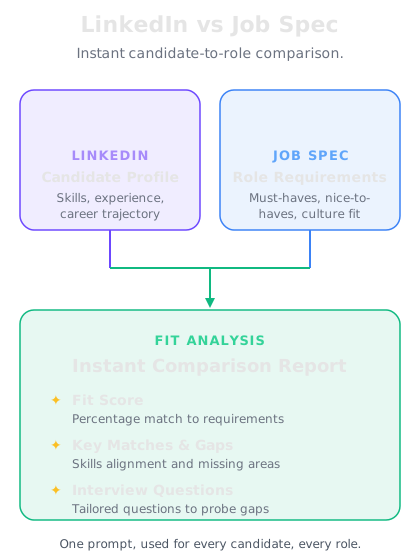
This is the single most time-saving prompt many recruiters build during this course. Instead of spending 10-15 minutes manually cross-referencing a candidate's experience against a JD, you paste two blocks of text and get a fit score, matching skills, gaps, interview talking points, and potential concerns — instantly.
You will use this for every candidate, every role, from this point forward.
The reusable fit-analysis prompt
Here is the master prompt. Save it somewhere you can access it quickly — your notes app, a pinned ChatGPT conversation, a custom GPT, or a text expander shortcut.
The prompt:
"I'm going to give you a candidate's LinkedIn profile and a job description. Analyze the fit and return the following:
1. Fit Score — A percentage (0-100%) indicating overall match
2. Matching Skills & Experience — Bullet list of where the candidate directly meets the JD requirements
3. Gaps & Missing Qualifications — Bullet list of JD requirements the candidate does not clearly demonstrate
4. Transferable Strengths — Skills or experience that are not exact matches but add value
5. Interview Talking Points — 3-5 specific questions to explore based on the gaps or interesting aspects of their background
6. Potential Concerns — Anything that might be a risk: short tenures, career gaps, overqualification, industry mismatch
7. Overall Recommendation — One sentence: proceed to interview, maybe with reservations, or pass
Here is the LinkedIn profile:
[PASTE LINKEDIN PROFILE TEXT]
Here is the job description:
[PASTE JD]"
That is it. One prompt, two inputs, seven outputs. Every time.
How to read the fit score
The fit score is a guideline, not a verdict. Here is how to interpret it:
85-100% — Strong match. The candidate hits most or all key requirements. Likely worth a conversation. Focus your interview on culture fit and growth potential rather than qualification verification.
70-84% — Solid match with some gaps. Most candidates worth interviewing fall in this range. The gaps section tells you exactly what to probe in the interview.
50-69% — Partial match. The candidate has relevant experience but is missing meaningful qualifications. Could work if the gaps are trainable or if the transferable strengths are strong.
Below 50% — Weak match. Significant gaps between the profile and the JD. Only proceed if the candidate brings something exceptional that the JD does not capture — a rare network, niche expertise, or unique perspective.
Remember: a 72% fit score with a candidate who is genuinely excited about the role often outperforms a 90% fit score with someone who is passively exploring. The prompt gives you data — your recruiter instinct adds the context.
Building this as a saved prompt or custom GPT
To get maximum efficiency, save this as a reusable tool you can access in one click:
Option 1 — Pinned conversation: In ChatGPT, start a conversation with the master prompt. Pin it. Every time you need to analyze a candidate, open that conversation and paste the new profile and JD.
Option 2 — Custom GPT: Build a simple custom GPT with the master prompt as its system instructions. Name it something like "Candidate Fit Analyzer." Now you have a dedicated tool in your sidebar — paste in the profile and JD, and it runs the analysis automatically.
Option 3 — Claude Project: Create a Claude Project with the master prompt as the project instructions. Upload the JD as a project file. Then for each candidate, just paste their LinkedIn profile and the analysis runs against the stored JD.
Option 4 — Text expander: If you use a text expander tool (TextExpander, Raycast, or even keyboard shortcuts), save the master prompt as a snippet. Type your trigger, the full prompt appears, and you paste in the details.
Whichever method you choose, the goal is the same: reduce the friction between "I found an interesting candidate" and "I know exactly how they fit this role" to under 60 seconds.
Using this for every candidate, every role
The real power of this prompt is not in any single analysis — it is in running it consistently across every candidate you evaluate.
When you use the same framework for every candidate on a role, three things happen:
Pattern recognition — After analyzing five or six candidates, you start seeing clear patterns. Maybe the market has plenty of candidates with skills A and B, but very few with skill C. That insight helps you advise hiring managers on what is realistic to expect.
Faster decisions — Instead of re-reading profiles three times trying to remember what you noticed, you have a structured summary you can reference in seconds. Your shortlist comes together in minutes, not hours.
Better hiring manager conversations — Instead of saying "I think this candidate is strong," you can say "They scored 81%. Strengths are X, Y, Z. Gaps are A and B. Here are the questions I'd ask to probe those gaps." That is a recruiter who gets taken seriously.