Your Recruitment Foundation
Seven days in. One week.
On Day 1, you might have been spending 80% of your time on admin and wondering why your best candidates kept going cold. Now you have a toolkit, a system, and a set of AI-powered skills that most recruiters won't learn for another year.
Let's take stock of everything you've built — and make sure it's locked in before Week 2 kicks off.
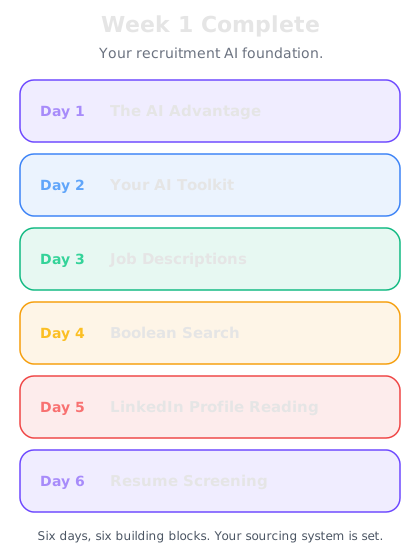
What you built this week
Day 1 — The mindset shift. You learned that the 80/20 problem is the core challenge of recruitment — 80% admin, 20% relationship-building. AI flips that ratio. The recruiter who uses AI doesn't work harder. They work on the right things.
Day 2 — Your toolkit. You set up three AI tools: ChatGPT for writing, Claude for analysis, and Perplexity for research. You know which tool to reach for based on the task. You installed the mobile app so you can screen candidates and draft messages from anywhere.
Day 3 — Job descriptions that attract. You learned to use AI to write inclusive, compelling JDs. You know how to separate must-haves from nice-to-haves, check for biased language, build a real EVP, and transform generic postings into ones that make qualified people want to apply.
Day 4 — Boolean search and sourcing. You can now generate boolean strings in seconds by describing your ideal candidate in plain English. You know how to create X-Ray searches for Google, GitHub, and alternative platforms. You source from channels most recruiters ignore.
Day 5 — LinkedIn profile reading. You mastered the 30-second assessment. Copy a profile, paste it with role requirements, get a structured evaluation — skills match, gaps, culture signals, red flags, and career trajectory. You can compare candidates side by side and build reasoned shortlists.
Day 6 — CV screening at scale. You learned to handle high-volume screening with a two-pass approach, build ranked shortlists, and use role-specific templates. You know how to use AI ethically — focusing on skills and evidence, not vibes and demographics.
The system you now have
Let's connect the dots. Here's what your AI-powered sourcing and screening workflow looks like when you put all six days together:
Step 1 — Brief You receive a new role from a hiring manager. You use AI to clarify the brief, separate must-haves from nice-to-haves, and ask smart questions about what "good" really looks like.
Step 2 — Job description You draft the JD with AI, run it through the inclusive language checker, build a compelling EVP, and post it. Time: 15 minutes instead of an hour.
Step 3 — Sourcing You paste the JD into AI and generate three tiers of boolean strings. You run X-Ray searches on Google and GitHub. You check alternative channels. Time: 20 minutes instead of 2-3 hours.
Step 4 — Profile assessment As sourcing results come in, you copy LinkedIn profiles into AI for 30-second assessments. You build a longlist of 15-20 promising candidates. Time: 30 minutes instead of 3-4 hours.
Step 5 — CV screening Applications arrive. You do a quick first-pass classification, then detailed assessment of the strong candidates. You build a ranked shortlist with structured notes. Time: 1-2 hours instead of 8-10 hours.
Step 6 — Shortlist You present your hiring manager with a ranked shortlist where every candidate has a clear summary, strengths, gaps, and recommendation. The hiring manager can make decisions quickly because the information is clear and consistent.
Total time: about 3-4 hours of active work. Compare that to 15-20 hours doing the same thing manually. And your output is higher quality — more comprehensive sourcing, more consistent screening, better-informed shortlists.
Numbers that matter
Let's put some real figures behind the transformation:
Time to shortlist: With AI, you can go from receiving a brief to presenting a ranked shortlist in 1-2 days instead of 1-2 weeks. In a competitive market, that speed is the difference between hiring your top candidate and losing them to a faster company.
Candidate quality: AI-improved JDs attract 25-40% more qualified applicants. Better boolean searches surface candidates you'd never have found manually. Structured screening catches strengths and flags you'd miss on your 30th CV of the day.
Consistency: Every candidate is evaluated against the same criteria, with the same level of attention, regardless of whether they were the first or the hundredth to apply. That's not just efficient — it's fairer.
Hiring manager satisfaction: When you present a shortlist with clear reasoning — not just a list of names — hiring managers make faster, more confident decisions. That reduces time-to-fill and builds trust in your process.
Your Week 1 challenge
Before you move to Week 2, here's a challenge: screen your next batch of candidates using AI.
Pick a role you're currently working on. Take the next 10-20 CVs or LinkedIn profiles that come in. Use the techniques from Days 5 and 6 to:
1. Assess each candidate in 30 seconds with a structured prompt
2. Build a ranked shortlist with clear reasoning
3. Present it to your hiring manager with structured notes
Compare the experience to how you used to screen. Notice how much faster it is. Notice how the quality of your notes improves. Notice how much more confident you feel about your shortlist.
That's the foundation. And it only gets more powerful from here.
What's coming in Week 2
Week 1 was about finding and evaluating candidates. Week 2 is about engaging them:
Day 8 — Outreach Messages That Get Replies. Write personalised InMails and emails that reference specific details from a candidate's background. Move your response rates from 15% to 35%+.
Day 9 — Follow-up Sequences. Build multi-touch outreach sequences that nurture passive candidates without being annoying.
Day 10 — Scheduling Without the Pain. Use AI to handle the back-and-forth of interview scheduling — saving hours every week.
Day 11 — AI-Powered Interview Prep. Generate role-specific interview questions, create scorecards, and brief yourself on candidates before every call.
Day 12 — Structured Interviewing with AI. Build consistent interview processes that reduce bias and improve hiring decisions.
Day 13 — Candidate Communication at Scale. Rejections, updates, offer letters — every piece of candidate communication, drafted and polished by AI.
Day 14 — Your Engagement Machine. Put it all together into a complete candidate engagement system.
Week 1 gave you the foundation. Week 2 turns you into a candidate engagement machine.