Understanding Lead Platforms
Before you can win more jobs with AI, you need to understand how lead platforms actually work — the mechanics behind the scenes that determine who gets hired and who gets ignored.
Whether you're on RatedPeople in Birmingham, Thumbtack in Dallas, or hipages in Melbourne, the fundamental model is the same. And once you understand it, you can use AI to exploit every advantage the system offers.
The platforms — a global overview
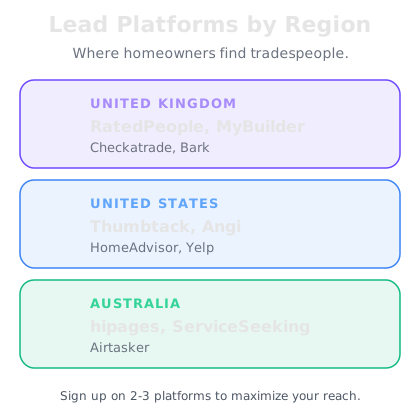
Lead platforms connect homeowners who need work done with tradespeople who can do it. Here are the major ones you should know about:
United Kingdom:
- RatedPeople — One of the biggest. Homeowners post jobs, tradespeople buy leads or pay for credits to respond. Competitive across all trades.
- MyBuilder — Similar model but with a focus on reviews and reputation. Tradespeople express interest, homeowners shortlist.
- Checkatrade — More of a directory model. You pay a monthly fee for a listing and profile. Homeowners search and contact you directly.
- Bark — Covers trades plus other services. Leads are sent to matched professionals. Credit-based system.
United States:
- Thumbtack — Massive platform. Pros set preferences and either get matched automatically or respond to leads. Pay-per-lead or pay-per-booking model.
- Angi (formerly Angie's List + HomeAdvisor) — One of the oldest. Combines a directory with lead generation. Homeowners request quotes, multiple pros get notified.
- Yelp — Not strictly a lead platform, but millions of homeowners use it to find local tradespeople. Your profile and reviews matter enormously here.
- HomeAdvisor — Now part of Angi but still operates separately in some areas.
Australia:
- hipages — The dominant platform. Tradespeople get job leads in their category and area. Credit-based system.
- ServiceSeeking — Similar to hipages. Homeowners post jobs, tradies quote.
- Airtasker — More general (not just trades) but widely used for handyman work, painting, gardening, and smaller jobs.
- OneFlare — Covers trades and home services. Quote-based system with reviews.
How the lead cycle works
Every platform follows the same basic cycle, regardless of country:
Step 1: Homeowner posts a job. "Need a bathroom refit in Leeds. Budget around 5K. Want to start next month." Or "Looking for a licensed electrician to rewire a 3-bed house in Phoenix." Or "Blocked drain in Parramatta, need someone ASAP."
Step 2: Platform matches tradespeople. Based on your location, trade category, and profile, the platform sends the lead to a handful of pros. On some platforms you get 3-5 competitors. On others, it could be 10-15.
Step 3: Tradespeople respond. This is where most jobs are won or lost. You send a message, a quote, or express interest. The homeowner sees your response alongside everyone else's.
Step 4: Homeowner chooses. They read the responses, check profiles and reviews, and pick someone to call or message further.
Step 5: Job is awarded. The tradesperson who made the best impression — usually a combination of speed, professionalism, and relevance — gets the work.
The critical moment is Step 3. That's where AI gives you an unfair advantage.
What homeowners actually want in a response
Research from multiple platforms reveals what homeowners value most when choosing a tradesperson. It's not just about price:
1. Speed — The first quality response gets 3x the engagement. On platforms like Thumbtack, responding within 5 minutes dramatically improves your odds. On RatedPeople, being in the first 3 respondents is crucial.
2. Personalization — Generic messages like "I can do this job, call me" get ignored. Homeowners want to see that you've actually read their job description and understood what they need.
3. Professionalism — Proper grammar, clear structure, and a confident tone signal that you're reliable. Rightly or wrongly, homeowners judge your work quality by your communication quality.
4. Relevant questions — Asking smart questions shows expertise. "Is the property a period home? That can affect the rewiring approach" instantly sets you apart from someone who just says "Yeah I can do that."
5. Credentials — Mentioning your qualifications, insurance, and years of experience builds trust before you've even met. Gas Safe registration, Part P certification, NICEIC membership, state licensing — whatever applies to your trade.
The economics of winning just one more job
Let's talk numbers, because this is what matters.
If you're paying for lead credits on platforms like RatedPeople or hipages, each lead might cost you between $5 and $30 depending on the job type. On Thumbtack, you might pay $15 to $50 per lead for larger jobs.
Now imagine you respond to 40 leads a month and win 8 jobs. That's a 20% win rate — pretty standard.
If AI helps you increase that to a 30% win rate — by responding faster, with better messages — you go from 8 jobs to 12. That's 4 extra jobs per month.
If your average job is worth $500 (a small plumbing repair, an electrical callout, a garden tidy-up), that's $2,000 in extra revenue per month. For larger jobs — kitchen refits, bathroom renovations, full rewires — the numbers are even bigger.
All from writing better responses. Not working longer hours. Not spending more on leads. Just communicating better, faster.