The Vibe Coding Community
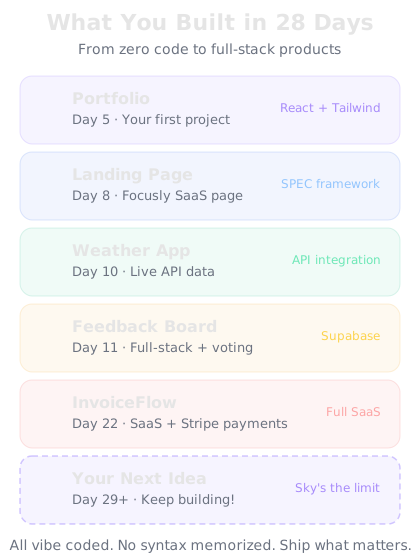
Twenty-eight days ago, you'd never vibe coded. Today, you can build and deploy full-stack applications, integrate payments, optimize performance, and ship real products — all through conversation with AI.
Let's look back at what you've accomplished and where you go from here.
What you learned
Week 1 — Foundations: You understood what vibe coding is, explored the tools, learned how AI generates code, set up your environment, built your first project, mastered the SPEC prompting framework, and learned to read AI-generated code.
Week 2 — Building real things: You built landing pages, added interactivity, connected to APIs, created full-stack apps with databases and authentication, and deployed to the internet.
Week 3 — Leveling up: You learned to debug with AI, refactor code, use Git for version control, work with existing codebases, write tests, optimize performance, and design for mobile.
Week 4 — Going pro: You built a SaaS product, integrated payments with Stripe, added SEO and analytics, secured your app, mastered advanced prompting, and understood when traditional coding knowledge helps.
That's not a tutorial. That's a skillset.
What to build next
The best way to keep improving is to keep building. Here are ideas to push your skills further:
Build something for yourself. A tool you'd actually use daily. A personal dashboard, a habit tracker, a bookmarks manager. When you're the user, you make better decisions.
Build something for someone else. A website for a friend's business. A tool for a colleague. Real users give real feedback — the best teacher.
Build something you can sell. A SaaS product, a template pack, a digital tool. Earning your first dollar from something you vibe-coded is a milestone that changes your relationship with building.
Join a hackathon. AI hackathons are everywhere. You have every skill you need to participate and build something impressive in 24–48 hours.
The landscape is evolving
Vibe coding tools improve every month. Keep an eye on:
AI models getting smarter. Every new model generation writes better code, understands more context, and makes fewer mistakes. What's hard today becomes easy tomorrow.
Tools getting more integrated. The line between "code editor" and "app builder" is blurring. Expect tools that combine the best of both — the speed of Bolt with the control of Cursor.
New platforms for shipping. Deployment is getting even simpler. One-click everything. AI that handles DevOps, monitoring, and scaling automatically.
Community-built resources. Templates, component libraries, prompt collections, and starter kits built specifically for vibe coders. The ecosystem is growing fast.
You're not late to this. You're early. The people building skills now will have an enormous advantage as these tools mature.
Share what you've built
The vibe coding community is one of the most supportive in tech. People love seeing what others build:
Show your work on social media. A before-and-after of your project, a screen recording of the build process, or a thread about what you learned. Tag it #VibeCoding.
Share your prompts. The prompts that produced great results are valuable to others. Post your best SPEC prompts, your debugging conversations, your iteration techniques.
Help beginners. You've been through the journey. Your experience is valuable to someone just starting Day 1. Answer questions, share tips, and pay it forward.
One more thing
Twenty-eight days ago, building software required years of training, expensive tools, and deep technical expertise. You needed to know programming languages, frameworks, deployment pipelines, database management, and dozens of other skills before you could bring a single idea to life.
Today, you need an idea and the ability to describe it clearly.
That's not a small change. That's a revolution. And you're now part of it.
Go build something amazing.