Day 1 of 28 · Vibe Coding Challenge
What Is Vibe Coding?
⏱ 5 min
📊 Beginner
Andrej Karpathy coined the term in February 2025. He said: "I just see things, say things, run things, and copy-paste things, and it mostly works."
That's vibe coding — building software by describing what you want in plain English and letting AI write the code. No syntax memorization. No Stack Overflow rabbit holes. Just you and an AI, building things together.
Today you'll learn what vibe coding is, why it's exploding, and why it changes who gets to build software.
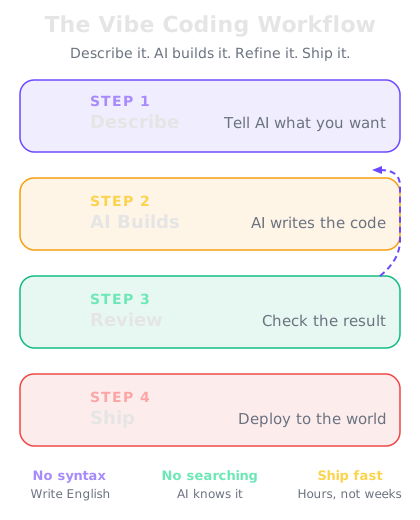
You describe it. AI builds it. You refine it. Ship it.
Knowledge Check
What is vibe coding?
A
Coding while listening to music for better focus
B
A new programming language designed for beginners
C
Building software by describing what you want in natural language and letting AI write the code
D
A method for debugging code using vibrations
Vibe coding is about communicating your intent in plain English (or any language) and having AI translate that into working code. You focus on what you want, not how to write it.
The old way vs. the new way
Here's what building a simple website used to look like:
1. Learn HTML, CSS, and JavaScript (weeks to months)
2. Set up a development environment
3. Write hundreds of lines of code
4. Debug cryptic error messages
5. Google every problem
6. Deploy through a complex pipeline
Here's what it looks like with vibe coding:
1. Describe what you want
2. Review what the AI built
3. Ask for changes
4. Ship it
Build me a personal portfolio website with a dark theme, an about section, a projects grid, and a contact form.
I'll create that for you. Here's what I'm building:
📄 **index.html** — Dark-themed portfolio with:
- Hero section with your name and title
- About section with bio placeholder
- Projects grid (6 cards with hover effects)
- Contact form with name, email, and message fields
🎨 **styles.css** — Dark color scheme, responsive layout, smooth animations
The site is ready. Want me to adjust anything — colors, layout, fonts?
Make the accent color electric blue and add a typing animation to the hero text.
Done ✓
Updated:
- Accent color → electric blue (#0066FF)
- Hero text has a typewriter animation
- All hover states and links now use the new accent
Anything else?
↻ Replay conversation
Knowledge Check
In the example above, what skill did the user need to build a portfolio website?
A
A computer science degree
B
JavaScript and animation libraries
C
The ability to clearly describe what they wanted
The user didn't write a single line of code. They described what they wanted, reviewed the result, and asked for tweaks. The only "skill" required was clear communication.
Who is vibe coding for?
This is the part that surprises people. Vibe coding isn't just for non-programmers. It's being used by:
Founders who need to build MVPs fast without hiring a dev team
Designers who want to turn their mockups into real, working code
Marketers who need landing pages, tools, and automations yesterday
Professional developers who want to move 10x faster on boilerplate and prototyping
Students who want to build real projects while they're still learning
Anyone with an idea who was previously locked out because they couldn't code
Knowledge Check
Vibe coding is only useful for people who don't know how to program. True or false?
A
False — even experienced developers use it to move faster
B
True — it produces low-quality code that real developers would reject
C
True — experienced developers don't need it
Professional developers are some of the biggest users of vibe coding. It lets them skip the tedious parts (boilerplate, configuration, repetitive patterns) and focus on architecture and logic. It's a productivity multiplier, not a replacement.
Why now?
Three things came together in 2024–2025 that made vibe coding possible:
AI models got good enough. Claude, GPT-4, and other models can now write production-quality code across dozens of languages and frameworks.
Purpose-built tools appeared. Cursor, Bolt, v0, Replit Agent — tools specifically designed for building software with AI, not just chatting about it.
The ecosystem matured. One-click deployment, managed databases, serverless hosting — the infrastructure to go from idea to live product got radically simpler.
I have an idea for a SaaS app that tracks freelancer invoices. Can AI actually build that?
Absolutely. Here's what a vibe-coded invoice tracker looks like:
✅ User authentication (login, signup)
✅ Dashboard with invoice list
✅ Create/edit/delete invoices
✅ PDF generation and download
✅ Payment status tracking
✅ Client management
✅ Basic reporting and charts
People are shipping apps like this in a weekend using AI coding tools. The tech stack, database design, and deployment — AI handles all of it.
Want to start building?
↻ Replay conversation
Knowledge Check
What made vibe coding possible in 2024–2025?
A
A single breakthrough invention
B
AI models got good enough, purpose-built tools appeared, and deployment infrastructure matured
C
Schools started teaching it
D
Programming languages became simpler
It was a convergence — better AI models, tools designed specifically for AI-assisted coding, and simpler deployment infrastructure. No single breakthrough, but three trends coming together at the right time.
What you'll build in this challenge
Over the next 27 days, you'll go from zero to shipping real projects:
Week 1 — Foundations: set up your tools, learn to prompt effectively, understand AI-generated code
Week 2 — Build real things: landing pages, interactive apps, full-stack projects with databases and auth
Week 3 — Level up: debugging, testing, version control, performance, responsive design
Week 4 — Go pro: SaaS products, payments, SEO, security, and advanced techniques
By Day 28, you'll have built and deployed multiple working projects — without writing code from scratch.
Final Check
After completing this challenge, what will you be able to do?
A
Build and deploy full working applications — from landing pages to SaaS products — using AI coding tools
B
Only build simple static websites
C
Write code in every programming language
D
Replace all software engineers at a company
You'll be able to take an idea, describe it to AI, guide the development process, and ship a working product. That's a real, valuable skill — and it's exactly what this challenge teaches.
🚀
Day 1 Complete
"Vibe coding isn't about writing code. It's about describing what you want and shipping what matters."
Tomorrow — Day 2
The AI Coding Toolkit
We'll explore the tools that make vibe coding possible — from Cursor to Claude to Bolt and beyond.