Day 7 of 14 · What's Coming
Your Wake-Up Call
⏱ 6 min
📊 Beginner
You've spent six days learning what's happening. Today, let's bring it all together — because this is the moment where understanding has to become decision.
What you now know
Let's recap the case we've built this week:
Day 1: A wave is coming that's bigger than most people realize. We're in the early phase of the steepest technology adoption curve in history.
Day 2: AI has already collapsed the gap between what one person can do and what a team used to be required for. This isn't theoretical — it's happening now.
Day 3: Most people who "tried AI" barely scratched the surface. The gap between casual use and skilled use is enormous.
Day 4: AI is improving at an unprecedented pace. Every expert prediction has been wrong in the same direction: faster than expected.
Day 5: The AI feedback loop — AI building better AI — means this acceleration is likely to increase, not slow down.
Day 6: Jobs aren't being "replaced" in a dramatic way. They're being compressed — same output, fewer people, rising expectations.
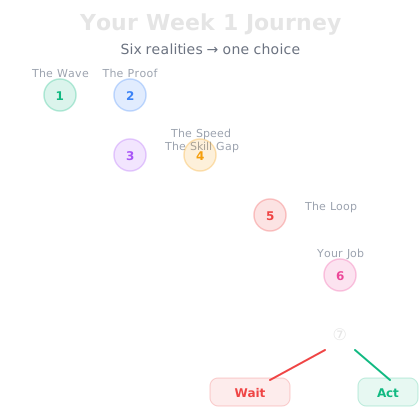
You've walked through six realities this week. Now you're standing at the fork — and the path you choose matters.
The fork in the road
You're standing at a fork. Both paths are real. Both have real consequences.
Path A: Wait and see. This is the path most people take. It feels safe. You'll keep doing what you're doing, check back on AI in six months, and figure it out when it becomes "necessary." This path feels rational but it has a cost — every month you wait, the adaptation curve gets steeper. The people who started six months ago are already ahead, and the gap compounds.
Path B: Start now. This path is uncomfortable because it requires change when there's no immediate crisis. But it has a massive advantage — you're adapting while the stakes are still low. Learning AI when it's optional is infinitely easier than learning it when your job depends on it.
The difference between these paths isn't about intelligence or talent. It's about timing. And right now, timing is everything.
I understand AI is important, but I'm overwhelmed. Where do I even start?
That feeling of overwhelm is completely normal — and it's actually a sign that you're taking this seriously.
Here's the good news: you don't need to become an AI expert. You just need to start. And starting is simpler than you think.
**This week, do one thing:**
1. Pick a task you do regularly at work (emails, reports, research, writing)
2. Open ChatGPT (free version is fine)
3. Ask it to help with that specific task
4. See what happens
That's it. No course to complete. No certification to earn. Just one real task, one AI tool, one experiment.
Next week in this course, we'll walk through exactly what to do — step by step. But even before then, that one experiment will shift your perspective more than any article or video ever could.
↻ Replay conversation
Knowledge Check
What's the core message of Week 1?
A
AI is dangerous and should be regulated before anyone uses it
B
AI won't affect most people's jobs for at least a decade
C
AI is transforming work faster than people expect, and the window to adapt while stakes are low is closing
D
Everyone needs to become a programmer to survive
Week 1 built the case that AI is bigger, faster, and closer than most people realize. The key insight isn't fear — it's urgency. The best time to adapt is while it's still optional, because the window won't be open forever.
Final Check
Why is "wait and see" a risky strategy for dealing with AI?
A
Early adopters get special features not available later
B
AI companies will charge more in the future
C
AI tools will become harder to use over time
D
Every month you wait, the adaptation curve gets steeper and those who started earlier gain a compounding advantage
The risk of waiting isn't that AI goes away — it's that the learning gap compounds. People adapting now are building skills, workflows, and intuitions that take time to develop. When AI becomes mandatory (not if), those who waited will face a much steeper climb.
🔥
Day 7 Complete
"The best time to adapt was six months ago. The second best time is today. Next week, we'll show you exactly how."
Tomorrow — Day 8
Start Using AI Today
Week 2 begins tomorrow with practical action — starting with the single most important step you can take right now.