Product Descriptions at Scale
This is the most important lesson in Week 1. The prompt template you learn today will save you more time than any other technique in this entire course.
You're going to learn how to take basic product specs — name, features, materials, target audience — and turn them into complete, platform-ready listings in minutes instead of hours. Not generic, robotic descriptions. Real, compelling copy that matches your brand voice and speaks to your customers.
By the end of today, you'll have a reusable template that works for any product on any platform. Tomorrow you'll optimize those descriptions for search. But first, let's get the descriptions right.
The product description prompt template
Every great product description starts with the same information. The key to getting consistent, high-quality output from AI is feeding it structured input. Here's the template:
Product Name: [What it's called]
Category: [Product type/category]
Key Features: [3-5 standout features or specs]
Materials/Ingredients: [What it's made of]
Dimensions/Size: [Physical specs]
Price Point: [Budget / mid-range / premium]
Target Customer: [Who buys this and why]
Brand Voice: [How your brand sounds — casual, luxury, technical, playful]
Platform: [Shopify, Amazon, Etsy, etc.]
Word Count: [Desired length]
You fill in the blanks. AI writes the description. The more detail you provide, the better the output. A 30-second investment in filling out this template saves 25 minutes of writing.
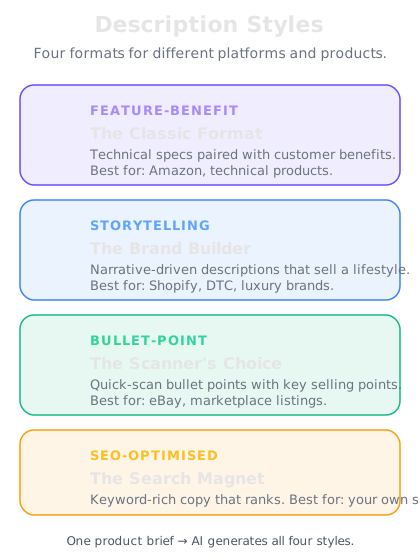
Four description styles for four types of products
Not every product gets the same treatment. A handmade leather wallet needs a different description than a budget phone case. Here are four templates you'll use constantly:
Luxury / Premium — Emphasize craftsmanship, materials, exclusivity, and the feeling of ownership. Longer sentences, sensory language, story-driven. "Handcrafted from full-grain Italian leather by artisans in Florence..."
Budget / Value — Lead with practical benefits and value. Short, punchy sentences. Focus on what the customer gets for the price. "Everything you need, nothing you don't. Fits 12 cards, RFID-blocking, under $15..."
Technical / Specs-Driven — For products where specs matter (electronics, tools, fitness gear). Lead with numbers and performance data. Organized, scannable format. "5,000mAh battery. IP68 waterproof. 47mm titanium case..."
Lifestyle / Story-Driven — For products sold on emotion and identity (fashion, home decor, gifts). Paint a picture of the customer's life with the product. "Sunday mornings just got better. This ceramic pour-over set turns your kitchen counter into a coffee ritual..."
When you use the prompt template, include which style fits your product. AI adapts instantly.
The batch processing workflow
Writing one description at a time is fine. Writing 50 at once is where AI becomes transformative. Here's the batch workflow:
Step 1 — Prepare your spreadsheet. Create a simple spreadsheet with columns for each field in the template: product name, category, key features, materials, target customer, and so on. Fill in one row per product. This is the step that requires your product knowledge.
Step 2 — Build your master prompt. Write one prompt that includes your brand voice, platform requirements, and desired format. This is the "frame" that stays the same for every product.
Step 3 — Feed products in batches. Copy 5-10 products from your spreadsheet and paste them into the chat along with your master prompt. AI generates all descriptions in one response.
Step 4 — Review and refine. Scan the outputs. Most will be ready to use. For any that need tweaks, tell the AI what to change — "Make product 3 more casual" or "Add the warranty info to product 7."
Step 5 — Export and upload. Copy the finished descriptions back to your spreadsheet and upload to your platform.
A 500-product catalog? Batch 50 at a time. Ten rounds of AI generation, with review time between each batch. An afternoon of work instead of six weeks.
Live demo — generating descriptions from specs
Let's see this in action. Watch how basic product specs transform into ready-to-post listings:
Adapting for different platforms
The same product needs different descriptions on different platforms. Here's how to adjust:
Amazon — Strict formatting rules. Titles have specific structures (Brand + Product + Key Feature + Size/Color). Descriptions support HTML. Bullet points are king. Always include backend search terms. Tell AI: "Format this for Amazon Seller Central with an optimized title, 5 bullet points, and a product description."
Etsy — Story and personality matter more here. Etsy buyers want to know the maker, the process, the inspiration. Tell AI: "Write this in first person as a maker. Include the story behind the product and why I chose these materials."
Shopify — You have the most freedom here. No character limits, full HTML support, and total control over your product page layout. Tell AI: "Write a full Shopify product description with a hook, feature highlights, and a closing line that encourages adding to cart."
eBay — Completeness wins on eBay. Buyers want every detail — measurements, condition, compatibility, shipping info. Tell AI: "Write a detailed eBay listing that covers every spec. Include item specifics and condition details."
You can even take one AI-generated description and say: "Now rewrite this for Amazon format" or "Adapt this for Etsy's audience." AI handles the translation between platforms in seconds.
Common mistakes to avoid
After teaching hundreds of sellers to use AI for product descriptions, here are the mistakes that come up most:
Too vague on the input. "Write a description for a blue shirt" gives you generic output. "Write a description for a men's slim-fit Oxford button-down in navy, 100% brushed cotton, for professionals who want to look sharp at the office without wearing a suit" gives you something you can actually use.
Not specifying the platform. Each platform has different rules, character limits, and audience expectations. Always tell AI which platform the description is for.
Skipping the review step. AI output is a strong first draft, not a final draft. Scan every description for accuracy — does the material match? Are the dimensions right? Is the price point reflected in the tone? This takes 30 seconds per listing and catches the occasional error.
Using the same prompt for everything. A handmade candle and a power tool need different approaches. Use the four description styles from earlier in this lesson to match your prompt to your product.